Tuesday, July 14, 2009

Win a Copy of Dracula the Un-Dead


>>Mailing List!

Join the mailing list and be entered to win a free advance
reading copy of Dracula the Un-Dead. (Our mailing list is
private, and your information will not be shared or sold.)

Giveaways are held each month through October.

Winners will be notified via email.

Join Now!

http://www.draculatheun-dead.com/stoker-signup.htm

Saturday, July 11, 2009

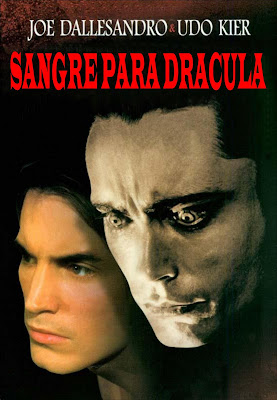
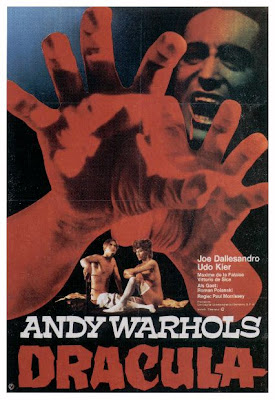
Andy Warhol's Dracula (1974)


Blood for Dracula (also known as Andy Warhol's Dracula
or Dracula cerca sangue di Vergine e morì di sete.)
is a 1974 film directed by Paul Morrissey (in Italy Antonio
Margheriti) and produced by Andy Warhol and Andrew
Braunsberg. It stars Udo Kier, Joe Dallesandro, Maxime
McKendry, Stefania Casini, and Arno Juerging. Roman
Polanski and Vittorio de Sica appear in cameo roles.


The film was shot on locations in Italy and was partly
improvised as the filming of Flesh for Frankenstein by the
same team had been quicker and less costly than expected.
Blood for Dracula was initially released to theaters in a 103-
minute version that was given an X rating by the MPAA due
to its violent and sexual elements; it was later cut to 94
minutes and reclassified with an R rating for re-release.
The original uncut version has been released to DVD
several times, though it is now unrated.


Synopsis:

A sickly and dying Count Dracula, who must drink virgin
(he pronounces it "wirgin") blood to survive, travels from
Transylvania to Italy. With a shortage of virgins in Romania
and thinking he will be more likely to find a virgin in a
Catholic country, Dracula befriends Marchese di Fiori (played
by de Sica), an impecunious Italian landowner who, with a
lavish estate falling into decline, is willing to marry off one
of his four daughters to the wealthy aristocrat.


Of di Fiori's four daughters, two regularly enjoy the sexual
services of Mario, the estate handyman (played by Dallesandro),
a Marxist with a hammer and sickle painted on his bedroom
wall. The youngest and eldest daughters are virgins, but the
latter is thought too plain to be offered for marriage, and is
past her prime, and the youngest is only fourteen years old
(portrayed by 23 year old Silvia Dionisio). Dracula obtains
assurances that all the daughters are virgins and drinks the
blood of the two who are considered marriageable. However,
both are non-virgins and their tainted blood makes Dracula
ill, but still turning the two girls into mental slaves.


Mario realizes the danger to the youngest daughter in time
and rapes her ostensibly for her own protection. But in the
meantime Dracula has drunk the blood of the eldest
daughter, turning her into a vampire. After the mother is
stabbed by Dracula's servant (whom she then shoots) and
Mario kills Dracula, the peasant Mario commands the estate.

Sunday, July 5, 2009

DRACULA LIVES


Dracula Lives was a magazine-sized, black-and-white-interior
comic from the 1970's, part of Marvel's larger effort to dominate
the comic-magazine field and do away with pesky rivals like
Warren Publishing. The effort was a failure, but some interesting
issues did come out of it, especially those devoted to horror and
monster themes.


Dracula Lives was on the shelves at the same time as the
longer-running Tomb of Dracula comic. The continuities of the
two overlapped, with storylines often weaving between the two;
most of the time, however, the magazine tales were stand-alone
stories, more generic adventures of the Count. Because of the
magazine format, DL could afford to be a little racier - but,
unfortunately, it rarely was. Instead, what we got were Dracula
stories by various creative teams from the Marvel stable,
alongside a partial adaptation of the original Bram Stoker
novel and articles on the Count's doings in the movies.


This provided a fairly decent mixture of material, but the
main meat of the magazine - the comic stories - were only
slightly above average most of the time. It was interesting
to see the King of Vampires in various historical periods and
different situations; but what this also meant was that the
internal consistency and continuity of stories was uneven
and ultiamately unsatisfying.


Dracula Lives ran for thirteen regular issues and one annual,
which contained reprint material.

You can see a gallery of Dracula Lives cover images here.

Friday, July 3, 2009

Dracula contra Frankenstein (1971)


Main Crew:

Director: Jess Franco
(Female Vampire 1973;
Virgin Among The Living Dead 1971;
Count Dracula 1970)
Producer: Interfilme / Fenix Films
Score: Bruno Nicolai / Daniel White
Writer: Jess Franco / Paul D'Ales
Director of photography: Jose Climent

Release date: 1971 France/Spain


Dracula (Howard Vernon) kills another innocent victim and
Dr. Seward (Alberto Dalbes) decides it's time to wipe him off
the face of the earth. Armed with a hammer and a wooden
stake, he arrives at Castle Dracula and duly dispatches the
vampire Count. Next day, however, Dr. Frankenstein (Dennis
Price) arrives with his assistant, Morpho (Luis Barboo), and a
large crate containing the monster (Fernando Bilbao).


Using the blood of a Cabaret singer (Josyane Gibert) who has
been abducted by his creation, the doctor brings Dracula back
to life and uses him for his own ends. The Count and a female
vampire (Britt Nichols) continue to terrorise the town, so
Dr Seward once again sets out for Castle Dracula.


Unfortunately, he is attacked by the Frankenstein monster
and left for dead. Amira, a gypsy (Genevieve Robert), rescues
him and summons up a werewolf (Brandy) to do battle with
the forces of evil...